DeerFlow 2.0 Deep Review: ByteDance’s Open-Source SuperAgent for 24/7 AI Workers
1. What is DeerFlow 2.0? From Deep Research to Super Agent Evolution
In February 2026, ByteDance officially released DeerFlow 2.0, a ground-up rewrite — sharing no code with version 1.x, incorporating 182 PRs, and transforming DeerFlow from a “deep research framework” into a full-fledged open-source SuperAgent engine.
DeerFlow stands for Deep Exploration and Efficient Research Flow. It has garnered over 83,000 Stars on GitHub, becoming one of the hottest open-source AI projects of 2026.
1.1 One-Line Positioning
DeerFlow 2.0 is an open-source SuperAgent Harness that orchestrates sub-agents, manages memory, and isolates sandboxes to accomplish virtually any complex task through an extensible skill system.
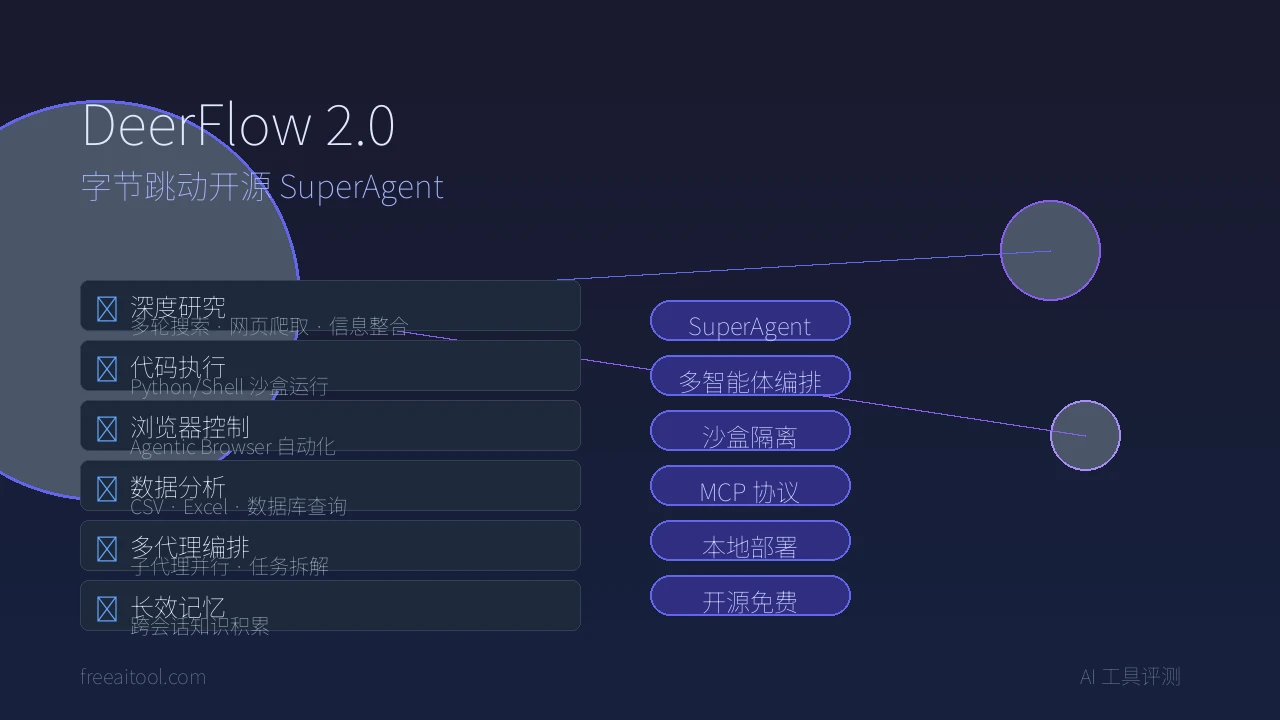
Unlike version 1.0, which only performed “deep research,” DeerFlow 2.0 can:
- 🔬 Deep Research: Multi-round search, web crawling, information synthesis
- 💻 Write Code: Execute Python/Shell in sandboxes, generate runnable programs
- 🌐 Browse the Web: Built-in Agentic Browser control for automated web operations
- 📊 Data Analysis: Process CSV, Excel, database queries
- 📝 Content Creation: Generate reports, presentations, documents
- 🤖 Multi-Task Orchestration: Decompose complex tasks for parallel sub-agent execution
1.2 Why Does It Matter?
| Feature | DeerFlow 2.0 | Traditional AI Assistants |
|---|---|---|
| Task Complexity | Long-horizon, multi-step, cross-domain | Single-turn Q&A |
| Execution Environment | Isolated sandbox, code execution | Text generation only |
| Memory | Cross-session persistent memory | No memory or short context |
| Tool Extension | MCP protocol + custom skills | Fixed feature set |
| Multi-Agent | Sub-agent orchestration, parallel processing | Single-agent sequential |
| Deployment | Fully local, data stays on-premise | Cloud API dependency |
2. Core Technical Architecture
DeerFlow 2.0’s architecture reflects ByteDance’s engineering experience with large-scale AI systems. Let’s break it down layer by layer.
2.1 Overall Architecture: Three-Layer Separation
┌─────────────────────────────────────────────────────┐
│           Client (Browser / TUI Terminal)            │
└──────────────────────┬──────────────────────────────┘
                       │
                       ▼
┌─────────────────────────────────────────────────────┐
│              Nginx Reverse Proxy (Port 2026)         │
│    /api/*  → Gateway API (8001)                      │
│    /*      → Frontend (3000)                         │
└──────────────────────┬──────────────────────────────┘
                       │
          ┌────────────┴────────────┐
          ▼                         ▼
┌──────────────────┐      ┌──────────────────┐
│  Gateway API     │      │   Frontend       │
│  (FastAPI:8001)  │      │  (Next.js:3000)  │
│                  │      │                  │
│ • Agent Runtime  │      │ • React UI       │
│ • LangGraph      │      │ • Chat Interface │
│   Compatible     │      │ • Project Docs   │
│ • SSE Streaming  │      │ • Artifact View  │
│ • MCP/Skills     │      │                  │
└──────────────────┘      └──────────────────┘
Key Design Decision: The Agent Runtime is embedded directly in the FastAPI Gateway rather than deployed as a separate LangGraph Server. This means less operational overhead — one process handles both API requests and Agent execution.
2.2 Middleware Chain: 8-Layer Processing Pipeline
Before each Agent execution, requests pass through 8 middleware layers:
- ThreadDataMiddleware — Initialize workspace, upload directory, output directory
- UploadsMiddleware — Process user-uploaded files (documents, images)
- SandboxMiddleware — Acquire sandbox execution environment
- SummarizationMiddleware — Context compression (prevent token overflow)
- TitleMiddleware — Auto-generate conversation titles
- TodoListMiddleware — Task tracking (plan mode)
- ViewImageMiddleware — Vision model support (image understanding)
- ClarificationMiddleware — Handle clarification requests
This middleware pattern borrows from web framework design philosophy — each layer has a single responsibility and is pluggable.
2.3 Sandbox System: Safe Code Execution
DeerFlow’s sandbox is the core capability distinguishing it from ordinary chatbots. Two modes are available:
| Mode | Use Case | Isolation Level |
|---|---|---|
| LocalSandbox | Local development, personal use | Process-level isolation |
| DockerSandbox | Production deployment, multi-user | Container-level isolation |
The sandbox supports full filesystem operations: execute commands, read/write files, list directories. All operations use virtual path mapping — Agents cannot access the host’s real filesystem.
2.4 Sub-Agent Orchestration: Task Decomposition & Parallelism
DeerFlow 2.0’s core innovation is the sub-agent orchestration system. When facing complex tasks, the Lead Agent will:
- Analyze the Task: Understand goals and constraints
- Decompose Subtasks: Break the large task into independently executable subtasks
- Assign Sub-Agents: Create specialized sub-agents for each subtask
- Execute in Parallel: Multiple sub-agents work simultaneously in their own sandboxes
- Aggregate Results: Collect all sub-agent outputs and synthesize the final result
# Sub-agent orchestration pseudocode
lead_agent.receive("Analyze pricing strategies of 10 competitors and generate a report")
  → sub_agent_1: Research pricing of competitors A, B, C
  → sub_agent_2: Research pricing of competitors D, E, F
  → sub_agent_3: Research pricing of competitors G, H, I, J
  → sub_agent_4: Aggregate data, generate comparison report
2.5 Persistent Memory System (DeerMem)
DeerFlow’s memory system has two layers:
- Session Memory: Current conversation context, persisted via LangGraph’s Checkpoint mechanism
- Long-Term Memory: Cross-session knowledge accumulation, stored on the local filesystem with semantic retrieval
Long-term memory enables DeerFlow to “remember” your previous work results, preferences, and project context — truly becoming smarter the more you use it.
2.6 Skills System
DeerFlow’s skill system is defined via Markdown files, with each skill containing:
- Trigger conditions (when to use this skill)
- Execution steps (what to do specifically)
- Tool dependencies (which tools are needed)
- Output format (how results are presented)
Skills can integrate with external services via the MCP (Model Context Protocol) protocol, or be fully custom.
3. Complete Deployment Guide
3.1 Environment Requirements
| Component | Minimum | Recommended |
|---|---|---|
| Python | 3.12+ | 3.12 |
| Node.js | 22+ | 22 LTS |
| Docker | 24+ | 24+ (production) |
| RAM | 8GB | 16GB+ |
| Disk | 10GB | 20GB+ |
3.2 Method 1: Docker Deployment (Recommended)
# 1. Clone the repository
git clone https://github.com/bytedance/deer-flow.git
cd deer-flow

# 2. Configure environment variables
cp .env.example .env
# Edit .env with your LLM API Key
# Supports: OpenAI, Anthropic, Google Gemini, Doubao, DeepSeek, etc.

# 3. Start services
docker compose up -d

# 4. Access
# Frontend: http://localhost:2026
# API: http://localhost:2026/api
3.3 Method 2: Local Development Deployment
# 1. Clone the repository
git clone https://github.com/bytedance/deer-flow.git
cd deer-flow

# 2. Backend setup
cd backend
python -m venv .venv
source .venv/bin/activate
pip install -e ".[dev]"

# Copy and edit configuration
cp config.yaml.example config.yaml
# Edit config.yaml to configure model API keys

# 3. Frontend setup
cd ../frontend
npm install

# 4. Start services
# Terminal 1: Start backend
cd backend && python -m app.gateway.app

# Terminal 2: Start frontend
cd frontend && npm run dev

# 5. Access http://localhost:3000
3.4 Model Configuration
DeerFlow supports multiple LLM providers. Official recommendations:
| Model | Use Case | Notes |
|---|---|---|
| Doubao Seed-2.0-Code | Coding tasks | ByteDance’s own, deeply integrated with DeerFlow |
| DeepSeek v3.2 | General tasks | Great value, strong Chinese |
| Kimi 2.5 | Long text processing | Ultra-long context window |
| Claude 3.5 Sonnet | Complex reasoning | First choice for English scenarios |
| GPT-4o | Multimodal tasks | Mixed image-text understanding |
Configure in config.yaml:
models:
  default:
    provider: openai
    model: deepseek-v3.2
    api_key: ${DEEPSEEK_API_KEY}

  reasoning:
    provider: anthropic
    model: claude-3.5-sonnet
    api_key: ${ANTHROPIC_API_KEY}
3.5 Sandbox Configuration
# config.yaml
sandbox:
  # Use LocalSandbox for local development
  provider: local

  # Use DockerSandbox for production
  # provider: docker
  # docker:
  #   image: python:3.12-slim
  #   memory_limit: "2g"
  #   cpu_limit: "2.0"
4. Practical Case: Competitive Analysis with DeerFlow
Let’s walk through a real case to experience DeerFlow 2.0’s capabilities.
4.1 Task Description
“Help me analyze the pricing strategies, core feature differences, and user sentiment of Notion, Obsidian, and Logseq. Generate a comparison report.”
4.2 DeerFlow’s Execution Process
Step 1: Task Decomposition
The Lead Agent breaks the task into 4 subtasks:
- Research Notion’s pricing, features, and user reviews
- Research Obsidian’s pricing, features, and user reviews
- Research Logseq’s pricing, features, and user reviews
- Aggregate and generate the report
Step 2: Parallel Execution
3 sub-agents launch simultaneously in sandboxes, each using browser tools to visit the target product’s website, pricing pages, and Reddit/G2 review pages.
Step 3: Information Aggregation
Each sub-agent organizes collected data into structured format and saves it to the sandbox filesystem.
Step 4: Report Generation
The aggregation sub-agent uses code execution tools to render the data as a Markdown report + comparison tables, outputting to the artifact directory.
The entire process takes about 3-5 minutes — doing the same work manually would take at least 2-3 hours.
5. Comparison: DeerFlow vs AutoGPT vs CrewAI vs LangGraph
| Dimension | DeerFlow 2.0 | AutoGPT | CrewAI | LangGraph |
|---|---|---|---|---|
| Positioning | SuperAgent Engine | Autonomous AI Agent | Role-playing Multi-Agent | State Graph Framework |
| Architecture | Middleware Chain + Sub-agents | Single-agent loop | Role collaboration | Directed graph state machine |
| Sandbox | ✅ Docker/Local | ❌ No native sandbox | ❌ No native sandbox | ❌ No sandbox |
| Memory | ✅ Cross-session persistent | ⚠️ Limited | ⚠️ Limited | ✅ Checkpoint |
| Skill Extension | ✅ Markdown skills + MCP | ⚠️ Plugins | ✅ Tool definitions | ✅ Custom nodes |
| Browser Control | ✅ Built-in | ✅ Available | ❌ Requires integration | ❌ Requires integration |
| Web UI | ✅ Beautiful Next.js interface | ⚠️ Basic UI | ❌ None | ⚠️ Studio |
| Deployment Difficulty | Medium (one-click Docker) | Simple | Simple | Medium |
| Use Case | Long-horizon complex tasks | Simple autonomous tasks | Clear role division | Fine-grained control flow |
| Stars | 83K+ | 170K+ | 30K+ | 15K+ |
| License | MIT | MIT | MIT | MIT |
5.1 Selection Guide
- Choose DeerFlow 2.0: Need long-horizon complex tasks, code execution sandbox, beautiful Web UI, data privacy (local deployment)
- Choose AutoGPT: Only need simple autonomous task loops, rapid prototyping
- Choose CrewAI: Tasks can be clearly divided into multiple roles, team collaboration simulation
- Choose LangGraph: Need fine-grained control over execution flow, building custom Agent applications
6. Highlights and Shortcomings of DeerFlow 2.0
✅ Highlights
- True SuperAgent Architecture: Not just a chatbot — an engine that orchestrates multiple sub-agents for complex tasks
- Security-First Sandbox: Docker-level isolation, code execution doesn’t affect the host
- Flexible Skill System: Markdown-defined skills, low barrier to entry, easy to share
- MCP Protocol Support: Can connect to external tools and services, open ecosystem
- Fully Local Deployment: Data never leaves your machine, suitable for enterprise privacy needs
- Beautiful Web UI: Built with Next.js, top-tier interaction experience
- ByteDance Backing: 83K+ Stars, active community, rapid iteration
⚠️ Shortcomings
- High Resource Consumption: Full deployment requires 16GB+ RAM, won’t run on lightweight VPS
- Model Dependency: Requires your own LLM API key, operating costs aren’t trivial
- Learning Curve: Many configuration options, beginners need time to get started
- Documentation Needs Improvement: Core documentation is primarily in English
- 2.0 Incompatible with 1.x: Upgrading requires a complete redeployment
7. Frequently Asked Questions
Q1: Is DeerFlow 2.0 free?
Yes, DeerFlow 2.0 uses the MIT open-source license and is completely free to use. However, running it requires LLM APIs (like DeepSeek, OpenAI, etc.), which incur API call costs.
Q2: Can DeerFlow run on machines without a GPU?
Yes. DeerFlow itself doesn’t run local models — it calls cloud LLMs via API. Therefore a CPU machine is sufficient, no GPU required.
Q3: What’s the difference between DeerFlow and ChatGPT?
ChatGPT is a cloud-based conversation product with data stored on OpenAI’s servers. DeerFlow is a locally-deployed Agent framework with data entirely on your machine. DeerFlow can also execute code, operate browsers, and manage files — things ChatGPT cannot do.
Q4: Which language models does DeerFlow support?
All major LLMs: OpenAI GPT-4o, Anthropic Claude, Google Gemini, DeepSeek, Doubao, Kimi, Qwen, etc. Connected via OpenAI-compatible APIs.
Q5: Is DeerFlow suitable for individual developers or enterprises?
Both. Individual developers can use LocalSandbox mode for quick start; enterprises can use DockerSandbox + multi-user isolation for production deployment.
Q6: How to upgrade from DeerFlow 1.x to 2.0?
2.0 is a complete rewrite — direct upgrade is not supported. You need to redeploy version 2.0. Version 1.x is still maintained on the main-1.x branch, but new feature development focuses on 2.0.
8. Conclusion
DeerFlow 2.0 represents an important milestone in open-source AI Agent frameworks. It’s no longer content with being a “chatting AI” — it has evolved into a thinking, executing, remembering 24/7 AI worker.
For developers, DeerFlow 2.0’s value lies in:
- Lowering AI application development barriers: No need to build Agent infrastructure from scratch
- Increasing complex task automation: Multi-agent orchestration lets AI actually “get work done”
- Ensuring data security: Fully local deployment, data never leaves your premises
If you’re looking for an open-source, powerful, locally-deployable AI Agent framework, DeerFlow 2.0 deserves serious evaluation.
Reference Links:
- DeerFlow GitHub Repository
- DeerFlow Official Website
- DeerFlow Architecture Docs
- ByteDance Coding Plan
Hope this deep analysis was helpful! If you’re already using DeerFlow 2.0, feel free to share your experience in the comments.