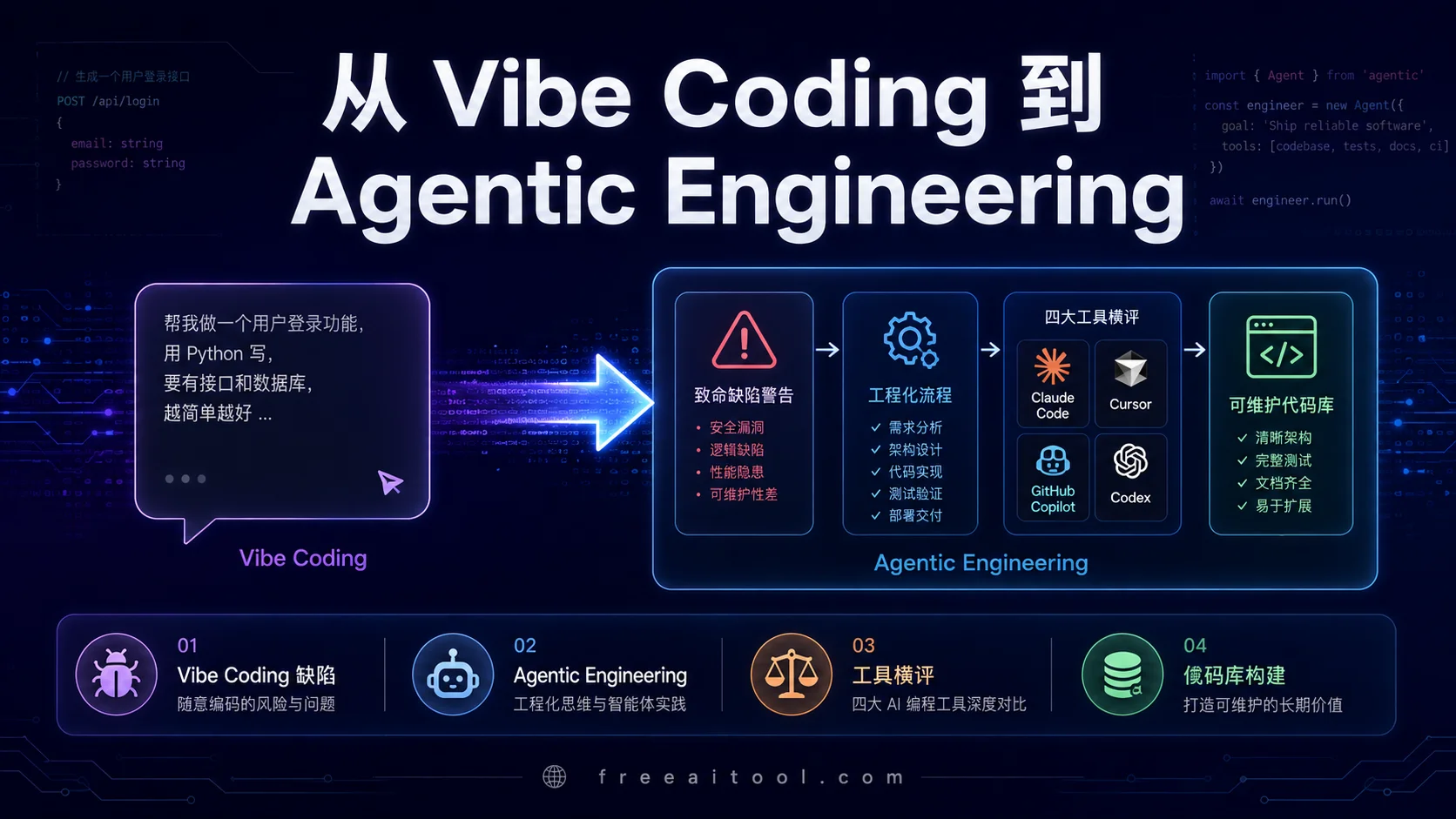
From Vibe Coding to Agentic Engineering: The Paradigm Shift in AI Programming in 2026
In February 2024, Andrej Karpathy coined the concept of Vibe Coding — “you fully embrace the vibe, lean into exponentials, and forget the code even exists.” The phrase spread like wildfire, becoming the mantra for countless developers writing code with AI.
Two years later, the wind has shifted.
On Hacker News, a post titled “After Two Years of Vibe Coding, I Went Back to Writing Code by Hand” scored 865 points, with the comment section filled with reflections on Vibe Coding. Meanwhile, at the Zhipu GLM-5 launch event, “From Vibe Coding to Agentic Engineering” became the core narrative, with 378 points of discussion signaling that this new term is rapidly capturing developers’ minds.
This isn’t a battle of terminology — it’s a fundamental shift in the programming paradigm.
I. The Fatal Flaws of Vibe Coding: Why “Coding by Feel” No Longer Works
1.1 What Is Vibe Coding?
The core idea of Vibe Coding is: You don’t need to understand the code — just describe your requirements in natural language and let AI generate the result. The typical workflow is:
- Describe the feature in natural language (“Build me a user login page”)
- AI generates the code
- Copy, paste, run
- Got an error? Throw the error message back to AI and try again
- It works? Call it a day
This workflow is indeed efficient during the prototyping phase. But when Vibe Coding is used in production, problems arise.
1.2 Three Fatal Flaws
Flaw #1: Uncontrolled Code Quality
The essence of Vibe Coding is “black-box generation” — you don’t look at the code, only the results. This leads to:
- Proliferation of duplicate code: AI generates “from scratch” every time, never reusing existing logic
- Accumulation of anti-patterns: AI tends to generate code that “works,” not code that’s “good”
- Exponential growth of technical debt: One developer shared that their Vibe Coding project accumulated 47 similar but distinct API call functions after just 3 months
Flaw #2: Zero Maintainability
When you don’t understand the code, you can’t maintain it. A Hacker News user’s comment hit the nail on the head:
“I used Vibe Coding for 6 months, and my project reached 50,000 lines of code. Then I hit a bug and spent 3 days trying to understand what the AI-generated code was doing. In the end, I rewrote the entire module.”
Flaw #3: Security Blind Spots
Vibe Coding’s “don’t review” philosophy means security issues are systematically overlooked. AI-generated code may contain:
- Hardcoded API keys
- SQL injection vulnerabilities
- Insecure dependency versions
- Missing input validation
A 2025 study showed that 38% of AI-generated code contains at least one moderate or above security vulnerability. In Vibe Coding mode, these issues are almost never caught.
1.3 The Real Problem with Vibe Coding
The problem with Vibe Coding isn’t that “AI-generated code is bad” — it’s that the developer’s role is incorrectly downgraded to “requirement describer.” You no longer think about architecture, review code, or understand the system — you’re just a messenger between AI and the client.
This isn’t programming. This is wishing.
1.4 A Real-World Case
Let me share a real case. A developer on Reddit shared their Vibe Coding experience:
“I used Cursor’s Composer mode to generate a complete SaaS project in 2 weeks, reaching 30,000 lines of code. Everything went smoothly at first, but when I tried to add a new feature, I found the system couldn’t scale at all. The AI-generated code had no unified architecture — each module was independent, data flow was chaotic, and dependencies were a tangled mess. In the end, I spent 3 weeks refactoring the entire project.”
This case reveals a critical issue: Vibe Coding excels in short-term projects but quickly spirals out of control in long-term ones.
II. Agentic Engineering: From “Prompts” to “Engineering”
2.1 What Is Agentic Engineering?
Agentic Engineering is a systematic upgrade to Vibe Coding. Its core philosophy is:
AI is not your code generator — it’s your engineering partner. Your job isn’t to “describe requirements” but to “guide, review, and integrate.”
Specifically, Agentic Engineering encompasses three layers:
- Agent as executor: AI agents (like Claude Code, Codex) autonomously handle code writing, testing, and debugging
- Human as architect: Developers are responsible for system design, code review, and quality control
- Engineering processes: Version control, CI/CD, code standards, security scanning — these traditional engineering practices aren’t discarded; they become even more important
2.2 Key Differences from Vibe Coding
| Dimension | Vibe Coding | Agentic Engineering |
|---|---|---|
| Developer Role | Requirement describer | Architect + Reviewer |
| Code Understanding | Don’t care | Must understand |
| Quality Control | As long as it runs | Engineering standards |
| Security Review | Ignored | Mandatory |
| Maintainability | Not considered | Core focus |
| Use Case | Prototypes, Demos | Production environments |
2.3 Why “Now”?
Agentic Engineering becoming mainstream in 2026 is no coincidence:
- Tool maturity: Tools like Claude Code, Codex, and OpenCode now have the capability to autonomously execute complex tasks
- Lessons learned: Two years of Vibe Coding practice have cost developers dearly
- Rising project complexity: AI-generated projects are growing larger — “going with the vibe” is no longer enough
III. Comparative Review of Four Major Agentic Coding Tools
The Agentic Coding tool market in 2026 has formed a four-way competition. Here’s my comparison based on 3 months of actual usage.
3.1 Tool Overview
| Feature | Claude Code | Cursor | Codex (OpenAI) | OpenCode |
|---|---|---|---|---|
| Positioning | Terminal-native Agent | IDE-integrated Agent | Cloud async Agent | Open-source terminal Agent |
| Runtime | Terminal CLI | VS Code fork | Cloud sandbox | Terminal CLI |
| Model | Claude Sonnet 4 / Fable 5 | Multi-model | GPT-5.6 / Codex | Multi-model |
| Price | $20/mo (Max $100-200) | $20/mo (Pro $40) | Included with ChatGPT Plus $20 | Free (bring your own key) |
| Context Window | 200K tokens | Project-level indexing | 128K tokens | Depends on model |
| Agent Mode | ✅ Native | ✅ Composer | ✅ Async | ✅ Native |
| Autonomous Execution | High (can run commands) | Medium (needs confirmation) | High (in sandbox) | High (can run commands) |
| Code Review | Built-in diff view | Built-in diff view | Web UI review | Terminal diff |
| MCP Support | ✅ Full | ✅ Full | ❌ Limited | ✅ Full |
| Open Source | ❌ | ❌ | ❌ | ✅ MIT |
3.2 Claude Code: The Terminal-Native All-Rounder
Advantages:
- Terminal-native, seamlessly integrates with development workflows
- 200K context window, handles large projects with ease
- Agent mode can autonomously run commands, execute tests, and fix errors
- Complete MCP ecosystem — connect to databases, APIs, and external tools
Disadvantages:
- Expensive (heavy usage requires the $100-200/month Max plan)
- Steep learning curve for the terminal interface
- Not ideal for frontend live-preview scenarios
Best for: Backend developers, full-stack developers, power users who prefer terminal workflows
3.3 Cursor: The Best IDE-Integrated Choice
Advantages:
- Built on VS Code, virtually zero learning curve
- Composer mode supports multi-file editing
- Live preview, excellent frontend development experience
- Multi-model support with flexible switching
Disadvantages:
- Less agent autonomy than Claude Code (many operations require confirmation)
- Project-level indexing can slow down on very large projects
- Limited terminal command support
Best for: Frontend developers, VS Code users, developers who prefer graphical interfaces
3.4 Codex: The Cloud-Async Pioneer
Advantages:
- Async execution — launch multiple tasks simultaneously
- Cloud sandbox with high security
- Deep GitHub integration, smooth PR workflows
- Included with ChatGPT Plus, great value
Disadvantages:
- No MCP support, limited extensibility
- Cloud execution means code must be uploaded to OpenAI
- Debugging experience falls short of local tools
- Limited support for non-OpenAI models
Best for: Security-conscious enterprise users, heavy GitHub users, developers who prefer async workflows
3.5 OpenCode: The Open-Source Challenger
Advantages:
- Fully open source (MIT license), freely customizable
- Supports any model (OpenAI, Anthropic, local models)
- Terminal-native, similar workflow to Claude Code
- Active community, fast iteration
Disadvantages:
- Requires your own API keys, costs can be unpredictable
- Ecosystem not as mature as commercial tools
- Relatively fewer docs and tutorials
Best for: Open-source enthusiasts, power users who want full control, budget-conscious but technically capable developers
3.6 Scenario-Based Recommendations
| Scenario | Recommended Tool | Reason |
|---|---|---|
| Backend API Development | Claude Code | Great terminal integration, strong agent autonomy |
| Frontend Component Development | Cursor | Live preview, excellent multi-file editing |
| Large Codebase Refactoring | Claude Code | 200K context, powerful processing |
| Security-Sensitive Projects | Codex | Cloud sandbox, strong isolation |
| Limited Budget | OpenCode | Free, bring your own key |
| Team Collaboration | Cursor / Codex | Cursor for real-time collaboration, Codex for async |
IV. Building Maintainable AI-Assisted Codebases: Best Practices
Upgrading from Vibe Coding to Agentic Engineering — tools are just the first step. What matters more is establishing an engineering process.
4.1 Architecture First: Think Before You Code
Principle: Don’t let AI decide your architecture.
Before starting a project, answer these questions:
- Module division: Which features are independent modules? What are the interfaces between them?
- Data flow: How does data flow between modules?
- Technology choices: What frameworks, databases, and ORMs?
- Code standards: Naming conventions, directory structure, comment style
Write these into an ARCHITECTURE.md file in the project root. Every time you launch an AI agent, have it read this file first.
# ARCHITECTURE.md

## Module Division
- `src/auth/`: Authentication module — handles login, registration, token management
- `src/api/`: API layer — handles routing and request processing
- `src/db/`: Data layer — handles database operations

## Interface Specifications
- All APIs return JSON format
- Error response format: `{ error: string, code: number }`

## Code Standards
- Use TypeScript strict mode
- Function naming: camelCase
- Type naming: PascalCase
- Every function must have JSDoc comments
4.2 Code Review: Trust, But Verify
Principle: Every line of AI-generated code must be reviewed.
Establish a code review checklist:
- Functional correctness: Does the code implement the expected functionality?
- Security: Are there hardcoded keys? Injection vulnerabilities?
- Performance: Are there obvious performance issues? (e.g., N+1 queries)
- Maintainability: Is the code easy to understand? Is there duplicated logic?
- Test coverage: Are there corresponding test cases?
Use AI to assist review, but the final decision must be made by humans.
4.3 Test-Driven: Have AI Write Tests First
Principle: Tests are the specification for code.
In Agentic Engineering mode, the recommended workflow is:
- Humans write test cases (or have AI generate tests from requirements)
- AI writes code to pass the tests
- Humans review the code and test results
This “test-driven” approach has several benefits:
- Test cases serve as the “specification” for code, giving AI a clear target
- Code correctness can be automatically verified
- Tests protect during refactoring, preventing regression
# Example: Test-driven workflow with Claude Code
$ claude
> Read tests/auth.test.ts, then implement src/auth/login.ts to make all tests pass
> Run the tests; if any fail, fix the code
> Do not modify the test files
4.4 Version Control: Commit Often, Describe Clearly
Principle: Every AI interaction should have a commit.
In Agentic Engineering mode, AI agents may make extensive code changes. To maintain traceability:
- Commit after each task: Have AI auto-generate commit messages after completing tasks
- Use semantic commits:
feat:,fix:,refactor:prefixes - Keep commits small: Each commit should contain only one logical change
# Example: Auto-generating commit messages with Claude Code
$ claude
> After completing the user login feature, generate a commit message following the Conventional Commits spec
> Then run git add and git commit
4.5 Security Scanning: Automated Security Checks
Principle: Security cannot rely on manual review alone.
Add automated security scanning to your CI/CD pipeline:
- Dependency scanning: Use
npm audit,safety check, etc. to check for dependency vulnerabilities - Code scanning: Use
semgrep,CodeQL, etc. to scan for code vulnerabilities - Secret scanning: Use
git-secrets,trufflehog, etc. to prevent key leaks
# Example: GitHub Actions security scanning workflow
name: Security Scan
on: [push, pull_request]
jobs:
  scan:
    runs-on: ubuntu-latest
    steps:
      - uses: actions/checkout@v4
      - name: Run Semgrep
        uses: returntocorp/semgrep-action@v1
      - name: Run npm audit
        run: npm audit --audit-level=high
V. Conclusion: The Future of Programming Is “Human-Machine Collaboration”
From Vibe Coding to Agentic Engineering is not a rejection of AI programming — it’s its maturation.
Vibe Coding taught us: AI can dramatically improve programming efficiency. Agentic Engineering taught us: Efficiency cannot come at the cost of quality.
Developers in 2026 no longer need to “write code,” but they need to “understand code.” Your value isn’t in how many lines of code you can write, but in whether you can:
- Design a clear architecture
- Guide AI to generate high-quality code
- Review and integrate AI’s output
- Ensure the system’s security and maintainability
This isn’t the end of programming — it’s the evolution of programming.
TL;DR: Vibe Coding’s “go with the feel” approach is no longer suitable for production environments. Agentic Engineering positions AI as an “engineering partner” rather than a “code generator,” requiring developers to take on architect and reviewer roles. When choosing tools: Claude Code for backend, Cursor for frontend, Codex for security-sensitive scenarios, and OpenCode for tight budgets. No matter which tool you use, the five best practices — architecture first, code review, test-driven, version control, and security scanning — are all indispensable.
Hope this blog post was helpful! If you have any questions or thoughts about Agentic Engineering, feel free to discuss in the comments.