Lovable Features Deep Dive
Natural Language Full-Stack App Generation
Lovable’s core interaction model is conversational development. You type your requirements in the chat panel on the left, and the preview window on the right shows the results in real time. Supported inputs include:
- Feature descriptions (“build a dashboard with user login”)
- UI adjustments (“change the button color to blue and make the font bold”)
- Logic changes (“add a filter that only shows completed tasks”)
- Data operations (“create a new data table to store user feedback”)
The whole process doesn’t require you to know React, Node.js, or SQL — but if you do, the code Lovable generates is fully readable and editable.
Built-In Supabase Database
Lovable’s integration with Supabase is its key advantage over other AI app builders:
- Automatic table creation: Database tables and relationships are auto-created based on your descriptions
- User authentication: One-click email login and Google/OAuth login
- File storage: Upload and manage user files
- Row Level Security: Data access permissions configured automatically
This means you can complete all the data-layer work for a full-stack app without ever leaving Lovable.
Live Preview and Iterative Editing
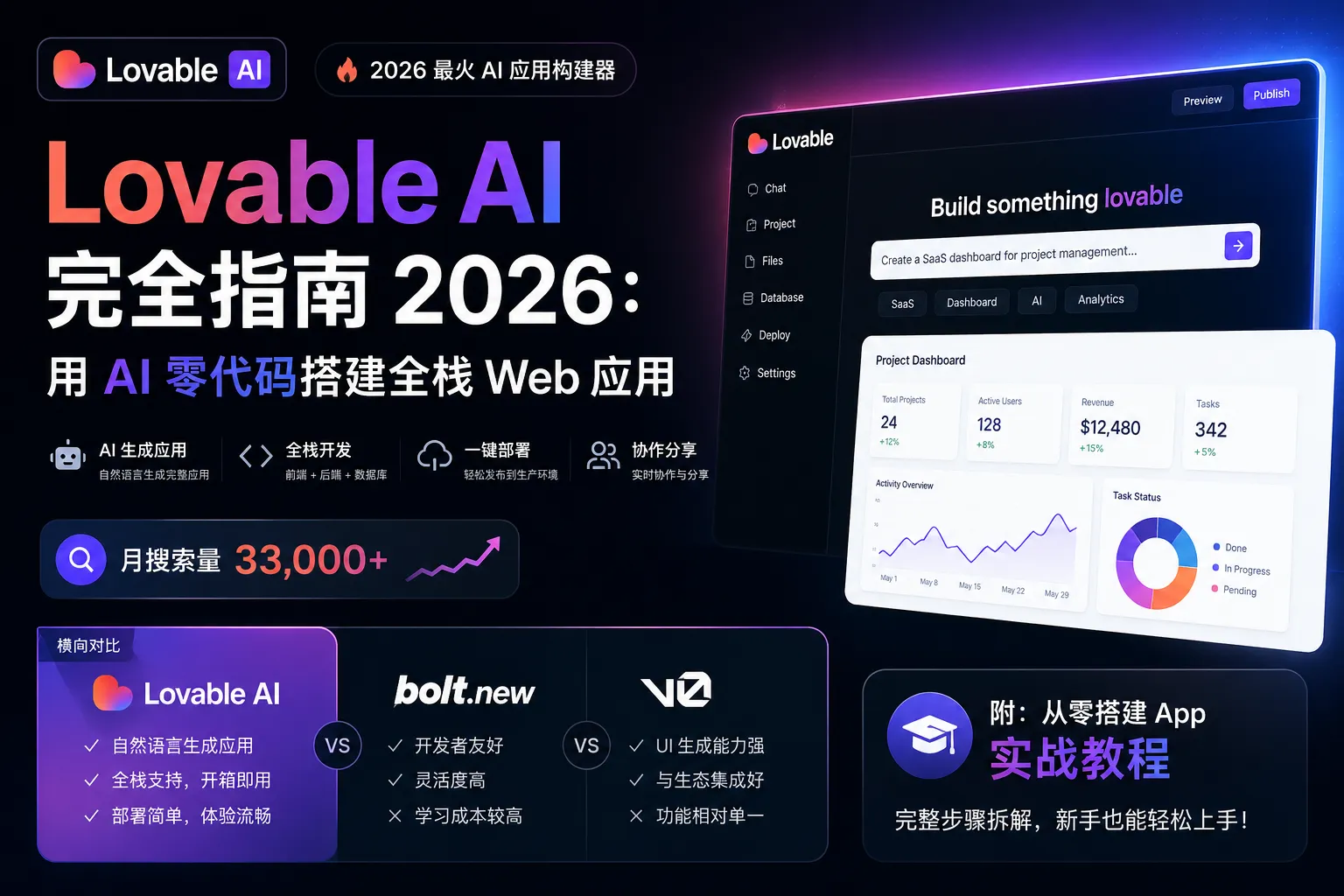
Lovable’s editor interface is divided into three areas:
- Chat panel (left): Enter requirements, describe changes
- Code panel (center): View generated code, supports manual editing
- Preview panel (right): See the app running in real time
You can switch to the code view at any time, manually modify the generated code, then go back to conversational mode to continue iterating. This flexibility is one of the key reasons Lovable appeals to developers.
Custom Code and Integration Ecosystem
Lovable supports a rich set of third-party integrations, including:
- Stripe: Payment and subscription management
- Google Maps: Maps and location services
- OpenAI API: AI feature integration
- n8n: 400+ automation workflow integrations through n8n
- Custom APIs: Connect to any external service via HTTP requests
Paid plans also support custom code injection, allowing you to add custom components and logic.
Lovable Pricing Explained (Updated May 2026)
⚠️ The pricing information below is current as of May 2026. Lovable may adjust pricing at any time — check the official pricing page for the latest details.
Lovable uses a Credit system, which is the most common question from users. Let’s break it down.
Plan Comparison
| Plan | Price | Credits | Key Features |
|---|---|---|---|
| Free | $0 | 20 credits (one-time) | Basic features, suitable for simple prototype validation |
| Pro | $25/mo (annual) | 100 credits/mo + 5 daily top-up | Custom domain, remove Lovable badge, user role permissions, custom code |
| Business | $50/mo (annual) | 100 credits/mo + team features | Internal publishing, SSO, team workspaces, design templates |
| Enterprise | Custom | Usage-based pricing | SCIM, audit logs, dedicated support |
| Student Discount | Up to 50% off | — | Available after student verification |
How Does the Credit System Work?
Credits are Lovable’s “fuel.” Every time you use natural language to describe a requirement for the AI to generate or modify code, credits are consumed. Specifically:
- Simple UI tweaks (changing colors, editing text): Low consumption
- Creating new data tables or pages: Medium consumption
- Complex feature development (e.g., integrating third-party APIs): High consumption
The Pro plan’s 100 credits/month plus the daily 5-credit top-up is generally sufficient for everyday iterative development. But if you need to build multiple apps at scale, you may want to consider the Business or Enterprise plan.
Is the Free Plan Enough?
The Free plan gives you 20 one-time credits, which means you can:
- ✅ Experience Lovable’s core features
- ✅ Build a simple prototype demo
- ❌ Develop multiple projects long-term
- ❌ Deploy to a custom domain
Bottom line: The Free plan is great for trying things out and evaluating. If you’re serious about building products with Lovable, you’ll need at least the Pro plan.
Lovable vs Bolt.new vs v0: Head-to-Head Comparison
All three tools claim to “generate web apps with AI,” but their positioning and capabilities vary significantly. Here’s our comprehensive comparison:
Feature Comparison
| Dimension | Lovable | Bolt.new | v0 |
|---|---|---|---|
| Full-Stack Capability | ✅ Complete (frontend + Supabase backend) | ⚠️ Primarily frontend | ❌ UI components only |
| Database Integration | ✅ Built-in Supabase | ❌ None | ❌ None |
| Custom Domain | ✅ From Pro plan | ⚠️ Limited | ❌ |
| Code Export | ✅ Full project | ✅ | ⚠️ Partial |
| User Authentication | ✅ One-click enable | ❌ | ❌ |
| Iterative Editing | ✅ Conversational | ✅ | ✅ |
| Third-Party Integrations | ✅ 14+ native + 400+ via n8n | ⚠️ Limited | ❌ |
| Test Suite | ✅ Built-in | ❌ | ❌ |
Pricing Comparison
| Tool | Free Plan | Paid Plan Starting Price | Paid Plan Core Benefits |
|---|---|---|---|
| Lovable | 20 credits (one-time) | $25/mo (annual) | Custom domain, full code, Supabase |
| Bolt.new | Limited credits | From $20/mo | More credits, custom domain |
| v0 (Vercel) | Limited credits | From $20/mo | More generations, team collaboration |
Search Popularity Comparison (Google Trends, Last 3 Months)
| Tool | Average Popularity | Peak | Current Popularity |
|---|---|---|---|
| Lovable AI | 63 | 100 (2026-03-08) | 48 |
| Bolt.new | 11 | — | 8 |
| v0 AI | <1 | — | <1 |
The data speaks for itself: Lovable’s search popularity is 6× that of Bolt.new, while v0 is barely searched at all. This isn’t a coincidence — Lovable’s full-stack capabilities and Supabase integration have genuinely created a differentiated position in the market.
Which Should You Choose?
- Choose Lovable if you need a complete full-stack app (frontend + database + user system) and want to quickly ship a product that’s ready to go live.
- Choose Bolt.new if you mainly need frontend prototypes, don’t have heavy backend requirements, and want a slightly lower budget.
- Choose v0 if you’re already in the Vercel ecosystem and just need to quickly generate UI components, handling the backend yourself.
💡 Lovable also has an official comparison page, but as a user, we recommend trying them all yourself before making a decision.
Hands-On: Building an App from Scratch with Lovable
Let’s walk through a real-world example showing how to build a deployable web app with Lovable in under 30 minutes.
Project goal: Build a personal blog management system with an article list, editor, and user login.
Step 1: Describe Your App
Open Lovable.dev and type the following into the editor:
Create a personal blog management system with the following features: the homepage displays an article list (including title, publish date, and summary); clicking an article title navigates to a detail page; support a Markdown editor for creating and editing articles; support user registration and login.
Within 1–2 minutes, Lovable will generate:
- Homepage (article list page)
- Article detail page
- Markdown editor page
- Login / registration page
- Supabase database tables (users, posts)
Step 2: Iterate and Refine
After the initial version is generated, you’ll likely find areas that need tweaking. Keep typing:
Change the article list on the homepage to a card layout, with each card showing an article cover image. Add a search box that lets users search articles by title.
Lovable will incrementally update the code, preserving existing features while adding new ones.
Step 3: Deploy and Go Live
In the Lovable editor:
- Click the Deploy button
- Choose to deploy on Lovable’s free domain (e.g.,
myapp.lovable.app) - (Pro users) You can connect a custom domain
The entire process requires no server configuration, no writing a Dockerfile, no touching the command line — that’s the power of an AI app builder.
FAQ
How Good Is the Code Generated by Lovable?
Lovable generates code based on React and TypeScript, following modern frontend best practices. The code structure is clean and can be viewed and edited directly on GitHub. For simple CRUD applications, the code quality is solid enough for production use.
Does Lovable Support Chinese Input?
Yes, Lovable supports describing requirements in Chinese. While the interface and generated code are in English, you can fully describe features and request changes in Chinese.
Can Users in China Access Lovable Normally?
Lovable.dev is accessible in most regions of mainland China, though occasional network fluctuations may affect performance. It’s a good idea to have a backup network solution ready.
What Types of Apps Can You Build with Lovable?
Lovable is well-suited for the following types of applications:
- Internal tools (CRM, inventory tracking, project management)
- SaaS product prototypes and MVPs
- Personal websites and blogs
- Simple e-commerce platforms
- Data dashboards and visualization tools
Can Lovable Replace Programmers?
No. Lovable excels at rapid prototyping and simple applications, but complex system architecture design, performance optimization, and security hardening still require professional developers. It’s more like an “AI coding assistant” than a replacement for programmers.
Conclusion
Lovable AI stands out as the most impressive tool in the 2026 AI app builder space. Its core advantages are:
- True full-stack capability: From frontend to database in one stop — unlike Bolt.new and v0, which can only handle the frontend.
- Deep Supabase integration: Out-of-the-box backend that dramatically lowers the barrier to full-stack development.
- Conversational development experience: Iterate and modify using natural language, friendly to non-technical users.
- Reasonable pricing: The Pro plan at $25/mo (annual) offers solid value for individual developers.
Of course, Lovable isn’t a magic bullet. Its Credit system may not be enough for heavy users, and the generated code still needs manual tweaking in complex scenarios. But as a tool for quickly validating ideas and building MVPs, it’s genuinely one of the best options available right now.
Our recommendation: Start with the Free plan to experience the core features, and upgrade to Pro if you find it works well for you. For founders, $25/month is far less than hiring a developer — and what you might get in return is a product prototype that changes the direction of your business.
🚀 Get started: Visit lovable.dev to sign up for free — 20 credits are enough to build a complete prototype.