ChatGPT Plugins Deep Dive: 5 Best Plugins to Master Any Subject
Learn EVERYTHING with ChatGPT. No more excuses.
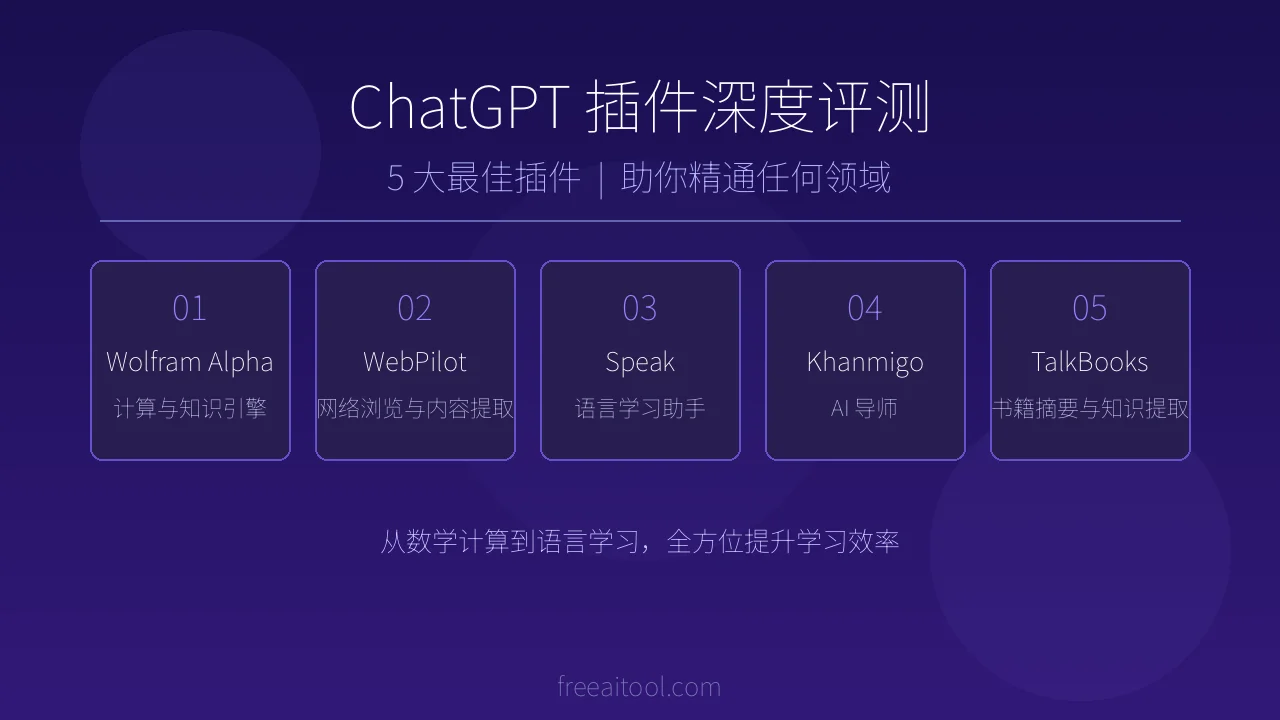
Back in July 2023, a tweet went viral on social media: “Learn everything with ChatGPT. No more excuses. Here are the 5 best plugins to master any field.” That single tweet racked up over 500K views, 1,000+ likes, and 2,500+ bookmarks.
Two years later, the ChatGPT plugin ecosystem has undergone a seismic shift. Today we’ll take a deep dive into those five classic plugins and see whether they’re still worth using in 2026.
1. The State of the ChatGPT Plugin Ecosystem
1.1 What Are ChatGPT Plugins?
ChatGPT plugins were launched by OpenAI in March 2023, enabling third-party developers to add new capabilities to ChatGPT. Plugins could:
- Access the internet: Search for the latest information in real time
- Run computations: Execute complex math and science calculations
- Call APIs: Interact with external services
- Process files: Read and analyze user-uploaded documents
1.2 Plugins vs. GPTs
In November 2023, OpenAI introduced GPTs (Custom GPTs), a simpler way to extend ChatGPT. Here’s how the two compare:
| Feature | Plugins | GPTs |
|---|---|---|
| Development effort | Requires API & auth | Just prompts + knowledge base |
| Capability scope | Can call external APIs | Primarily prompt-driven |
| Access requirements | ChatGPT Plus needed | Available to free users too |
| Maintenance cost | Ongoing API upkeep | Virtually zero maintenance |
| Current status | Phased out | The mainstream extension method |
Important note: OpenAI officially retired the Plugin Store in April 2024. The original plugin capabilities have been folded into GPTs and Actions. That said, the five plugins discussed in this article still live on — their core functionality continues through GPTs or official integrations.
2. Deep Dive into the 5 Learning Plugins
2.1 Wolfram Alpha — The Computational Knowledge Engine
Core capabilities: Math computation, data analysis, scientific queries, real-time data
Wolfram Alpha was one of the earliest and most successful ChatGPT plugins. It combines ChatGPT’s language understanding with Wolfram Alpha’s computational engine, letting users ask complex math and science questions in plain English.
Typical use cases:
User: Solve x^3 - 6x^2 + 11x - 6 = 0
ChatGPT + Wolfram: x = 1, 2, 3 (with step-by-step working and a graph)

User: Calculate the flight distance and carbon emissions from Beijing to Tokyo
ChatGPT + Wolfram: Distance ≈ 2,100 km, CO₂ emissions ≈ 240 kg
Status in 2026: Wolfram Alpha’s functionality has been integrated into ChatGPT’s default capabilities. Plus subscribers can use advanced computation directly. A standalone Wolfram Alpha GPT version is also still available.
Strengths:
- Precise mathematical computation and symbolic manipulation
- Covers specialized domains: physics, chemistry, engineering
- Real-time data (stocks, weather, exchange rates)
Limitations:
- Struggles with ambiguous queries
- Some advanced features require a separate subscription
2.2 WebPilot — Web Browsing & Content Extraction
Core capabilities: Web page access, content summarization, information extraction
WebPilot gave ChatGPT the ability to browse the internet, read web pages, and answer questions based on their content. This was essential for accessing up-to-date information, since ChatGPT’s base model has a knowledge cutoff.
Typical use cases:
User: Summarize the key points of this article [URL provided]
ChatGPT + WebPilot: The core arguments are... (3-5 key takeaways)

User: Compare the pricing and features of these three products [3 product page URLs]
ChatGPT + WebPilot: Product A costs $99, features include...; Product B...
Status in 2026: WebPilot’s core functionality has been superseded by ChatGPT’s built-in Browsing with Bing feature. Plus subscribers can have ChatGPT search and access web pages directly.
Strengths:
- Real-time access to the latest information
- Supports multi-page comparative analysis
- Auto-generates content summaries
Limitations:
- Some sites block access
- Long pages may get truncated
2.3 Speak — Language Learning Assistant
Core capabilities: Language learning, pronunciation practice, grammar correction, conversation practice
Speak is a plugin purpose-built for language learning, offering an immersive environment. It doesn’t just explain grammar rules — it also conducts real-time conversation practice.
Typical use cases:
User: Order a coffee in Japanese
ChatGPT + Speak:
[Japanese] コーヒーを一杯ください。
[Pronunciation] Kōhī o ippai kudasai.
[Explanation] This is a polite expression, suitable for coffee shops or restaurants.
[Practice] Now you try — which kind of coffee would you like to order?
Status in 2026: Speak has evolved into a standalone AI language-learning app available on mobile and web. ChatGPT’s own language-learning abilities have also improved dramatically, now supporting voice conversation mode.
Strengths:
- Supports 20+ languages
- Provides pronunciation guidance and correction
- Context-based learning (travel, business, daily life)
Limitations:
- Advanced features require a subscription
- Can’t fully replace real human conversation practice
2.4 Khanmigo — The AI Tutor
Core capabilities: Personalized teaching, Socratic questioning, homework help, concept explanation
Khanmigo is an AI tutor developed by Khan Academy in partnership with OpenAI, drawing on Khan Academy’s 10+ years of teaching expertise. Rather than handing out answers, it guides students to understanding through Socratic questioning.
Typical use cases:
Student: I don't understand the vertex form of a quadratic function
Khanmigo: Let's take it step by step. Do you remember the standard form y = ax² + bx + c?
Student: Yes
Khanmigo: Great. If I tell you the vertex form is y = a(x-h)² + k, where (h,k) is the vertex,
          what do you think the relationship is between h, k and a, b, c?
Student: Not sure
Khanmigo: That's fine. Let's look at an example: y = 2(x-3)² + 4.
          Expand this expression and see what you get...
Status in 2026: Khanmigo has become Khan Academy’s flagship product, offering free AI tutoring. ChatGPT itself now has similar teaching capabilities, but Khanmigo’s pedagogy is more systematic.
Strengths:
- Grounded in cognitive science
- Covers K-12 through university-level courses
- Genuine guided learning, not just answer delivery
Limitations:
- Primarily focused on academic subjects
- Some features require school or institution subscriptions
2.5 TalkBooks — Book Summaries & Knowledge Extraction
Core capabilities: Book summaries, key concept extraction, reading recommendations
TalkBooks let users quickly absorb the core ideas of a book without reading the whole thing. It provided detailed chapter summaries, key concept explanations, and book recommendations based on user interests.
Typical use cases:
User: Summarize the core ideas of "Thinking, Fast and Slow"
ChatGPT + TalkBooks:
The book centers on two systems of human thought:
1. System 1: Fast, intuitive, automatic
2. System 2: Slow, deliberate, effortful

Key concepts:
- Anchoring effect: We're easily influenced by the first information we receive
- Loss aversion: The pain of losing > the pleasure of gaining
- Availability heuristic: We judge probability by how easily examples come to mind

Application: These concepts explain why we make systematic errors in investing and decision-making.
Status in 2026: TalkBooks as a standalone service has shut down, but its functionality has been absorbed into ChatGPT’s native capabilities. ChatGPT can provide summaries and analysis based on book information from its training data.
Strengths:
- Quickly grasp a book’s core content
- Offers multi-angle analysis
- Supports cross-book concept comparison
Limitations:
- Can’t replace deep reading
- Limited coverage of new releases
3. Plugin Comparison & Selection Guide
| Plugin | Best for | Learning stage | Alternative | Pricing |
|---|---|---|---|---|
| Wolfram Alpha | Math, science, engineering | Intermediate–advanced | ChatGPT native computation | Included in Plus |
| WebPilot | Information retrieval, research | All stages | Browsing feature | Included in Plus |
| Speak | Language learning | Beginner–intermediate | ChatGPT voice mode | Separate subscription |
| Khanmigo | Academic tutoring | K-12, university | ChatGPT teaching mode | Free / institutional subscription |
| TalkBooks | Quick learning, reading | All stages | ChatGPT native capabilities | Included in Plus |
Recommendations
If you’re a student: Prioritize Khanmigo for structured learning, paired with Wolfram Alpha for math problems.
If you’re a professional: The WebPilot (now Browsing) + Wolfram Alpha combo is ideal for research and data analysis.
If you want to learn a language: Speak remains the top choice, or use ChatGPT’s voice conversation mode.
If you want to quickly understand a field: Just ask ChatGPT directly — it already has TalkBooks’ core capabilities built in.
4. Hands-On Tutorial: How to Learn Efficiently with ChatGPT
4.1 Create a Study Plan
Example prompt:
I want to learn data science in 3 months, 1 hour per day.
I have Python basics but no statistics background.
Please create a detailed study plan including:
1. Weekly learning objectives
2. Recommended resources (free first)
3. Practice project suggestions
4. Progress check methods
4.2 Deep-Dive Into a Concept
Example prompt:
Explain "gradient descent" using the Feynman technique:
1. Start with a simple analogy (for a 10-year-old)
2. Then give the technical definition (for a college student)
3. Finally show a Python implementation
4. Point out common misconceptions
4.3 Code Example: Gradient Descent in Python
import numpy as np

def gradient_descent(X, y, learning_rate=0.01, iterations=1000):
    """
    Gradient descent implementation for linear regression

    Parameters:
    X: Feature matrix (m, n)
    y: Target vector (m,)
    learning_rate: Step size
    iterations: Number of iterations

    Returns:
    theta: Optimal parameters
    cost_history: Loss history
    """
    m = len(y)
    theta = np.zeros(X.shape[1])
    cost_history = []

    for _ in range(iterations):
        # Predict
        y_pred = X.dot(theta)

        # Compute gradient
        gradient = (1/m) * X.T.dot(y_pred - y)

        # Update parameters
        theta -= learning_rate * gradient

        # Record cost
        cost = (1/(2*m)) * np.sum((y_pred - y)**2)
        cost_history.append(cost)

    return theta, cost_history

# Example usage
X = np.array([[1, 1], [1, 2], [1, 3], [1, 4]])  # Bias term included
y = np.array([2, 4, 6, 8])

theta, costs = gradient_descent(X, y)
print(f"Optimal parameters: {theta}")
print(f"Final cost: {costs[-1]:.4f}")
4.4 JavaScript Example: Building a Learning Progress Tracker
class LearningTracker {
  constructor(subject, goalHours) {
    this.subject = subject;
    this.goalHours = goalHours;
    this.sessions = [];
  }

  addSession(hours, topic) {
    this.sessions.push({
      date: new Date(),
      hours,
      topic,
      completed: true
    });
  }

  getTotalHours() {
    return this.sessions.reduce((sum, s) => sum + s.hours, 0);
  }

  getProgress() {
    return (this.getTotalHours() / this.goalHours) * 100;
  }

  getRemainingHours() {
    return Math.max(0, this.goalHours - this.getTotalHours());
  }

  getEstimatedCompletionDate(dailyHours = 1) {
    const remaining = this.getRemainingHours();
    const days = Math.ceil(remaining / dailyHours);
    const date = new Date();
    date.setDate(date.getDate() + days);
    return date;
  }

  generateReport() {
    const total = this.getTotalHours();
    const progress = this.getProgress();
    const remaining = this.getRemainingHours();
    const eta = this.getEstimatedCompletionDate();

    console.log(`\n=== ${this.subject} Study Report ===`);
    console.log(`Studied: ${total.toFixed(1)} / ${this.goalHours} hours`);
    console.log(`Progress: ${progress.toFixed(1)}%`);
    console.log(`Remaining: ${remaining.toFixed(1)} hours`);
    console.log(`Estimated completion: ${eta.toLocaleDateString('en-US')}`);
  }
}

// Usage example
const tracker = new LearningTracker('Data Science', 100);
tracker.addSession(2, 'Python Basics');
tracker.addSession(1.5, 'NumPy Arrays');
tracker.addSession(2.5, 'Pandas Data Processing');
tracker.generateReport();
5. Case Studies: Real-World Success Stories
Case 1: From Zero to Data Scientist
Background: Xiao Wang, with a marketing background, wanted to transition into data science
Learning path:
- Month 1: Learned Python basics with ChatGPT, 1 hour per day
- Month 2: Studied statistics and probability, using Wolfram to verify calculations
- Month 3: Learned machine learning fundamentals, using ChatGPT to explain algorithm principles
- Months 4–6: Worked on practice projects, using ChatGPT to debug code and understand errors
Result: Successfully transitioned to a data analyst role within 6 months, with a 40% salary increase
Case 2: Breaking Through in Language Learning
Background: Ms. Li wanted to work in Japan and needed to reach JLPT N2 level within 6 months
Learning methods:
- 30 minutes of daily conversation practice with Speak
- Grammar and vocabulary study with ChatGPT
- Reading Japanese news sites using WebPilot
- Weekly scenario-based conversation practice with ChatGPT
Result: Passed the N2 exam in 5 months and successfully received a job offer in Japan
6. Future Trends & Learning Resources
6.1 AI Learning Trends in 2026
- Multimodal learning: Integrated study combining text, images, audio, and video
- Personalized learning paths: AI tailors content to individual progress and learning style
- Real-time feedback: Instant error correction and reinforcement of correct understanding
- Immersive experiences: VR/AR + AI creating realistic learning scenarios
6.2 Recommended Learning Resources
Free resources:
- Khan Academy - Comprehensive academic courses
- Coursera - University courses (some free)
- freeCodeCamp - Programming education
- ChatGPT - AI-assisted learning
Paid resources:
- Coursera Plus - Unlimited course access
- Speak - Language learning
- Brilliant - Math and science
7. FAQ
Q1: Do ChatGPT plugins still cost extra?
A: The original Plugin Store was shut down in 2024. Most plugin functionality has been integrated into the ChatGPT Plus subscription ($20/month). Free users can access basic GPTs, but advanced features (like browsing and advanced computation) require a Plus subscription.
Q2: Are these plugins suitable for beginners?
A: Absolutely. ChatGPT can adjust the depth of its explanations to match your level. You can simply say “I’m a beginner, please explain in simple terms” and it will adapt accordingly. Khanmigo is especially great for beginners since it uses guided teaching.
Q3: Is using ChatGPT for learning considered cheating?
A: It depends on how you use it. If you use ChatGPT to complete assignments without understanding the material, that’s cheating. If you use it to understand concepts, clarify difficult points, and practice skills, that’s legitimate learning support. The key is to think actively rather than passively accepting answers.
Q4: Which plugin is best for learning to code?
A: ChatGPT itself is the most powerful coding learning tool. You can:
- Have it explain how code works
- Ask it to help debug errors
- Request practice exercises and project suggestions
- Get code reviews
Pairing it with Wolfram Alpha helps solve the math problems that come up in algorithms.
Q5: How can I maximize my learning outcomes?
A: Follow these principles:
- Active recall: After studying, try explaining the concept yourself
- Spaced repetition: Regularly review previous material
- Practical application: Reinforce knowledge through projects
- Teach others: Explain what you’ve learned to ChatGPT and let it point out misunderstandings
- Set goals: Clear learning objectives and a time plan
Conclusion
From 2023 to 2026, ChatGPT’s plugin ecosystem has evolved from a flourishing marketplace to an integrated system. Of the original five plugins, some have grown into independent products (like Speak and Khanmigo), while others have been absorbed into ChatGPT’s core capabilities (like Wolfram, WebPilot, and TalkBooks). But the learning philosophy they represent — empowering personal learning with AI — remains the right direction.
Most importantly: tools are just aids — real learning happens when you think actively and practice deliberately. No matter how powerful ChatGPT is, it can never replace your own effort.
“Learn EVERYTHING with ChatGPT. No more excuses.”
Now, start your learning journey.
Related resources:
Hope you found this article helpful!