Have you encountered this situation: with the same prompt, others get ChatGPT outputs far superior to yours? The problem isn’t the model—it’s the structural design of your prompts.
This article will take you from scratch through the complete methodology of structured prompt design—the CRISPE framework—and provide 10 industry templates you can directly reuse, helping you upgrade from “random questioning” to “systematic prompt engineering.”
What Are Structured Prompts?
Structured prompts are prompts organized according to specific frameworks, transforming vague natural language requests into clear, repeatable, high-quality instructions. Compared to casually entered natural language, structured prompts have three core characteristics:
- Repeatability: Same inputs produce stable output quality
- Maintainability: Modular design facilitates iterative optimization
- Reusability: Templated structures adapt to multiple scenarios
CRISPE Framework Detailed Explanation
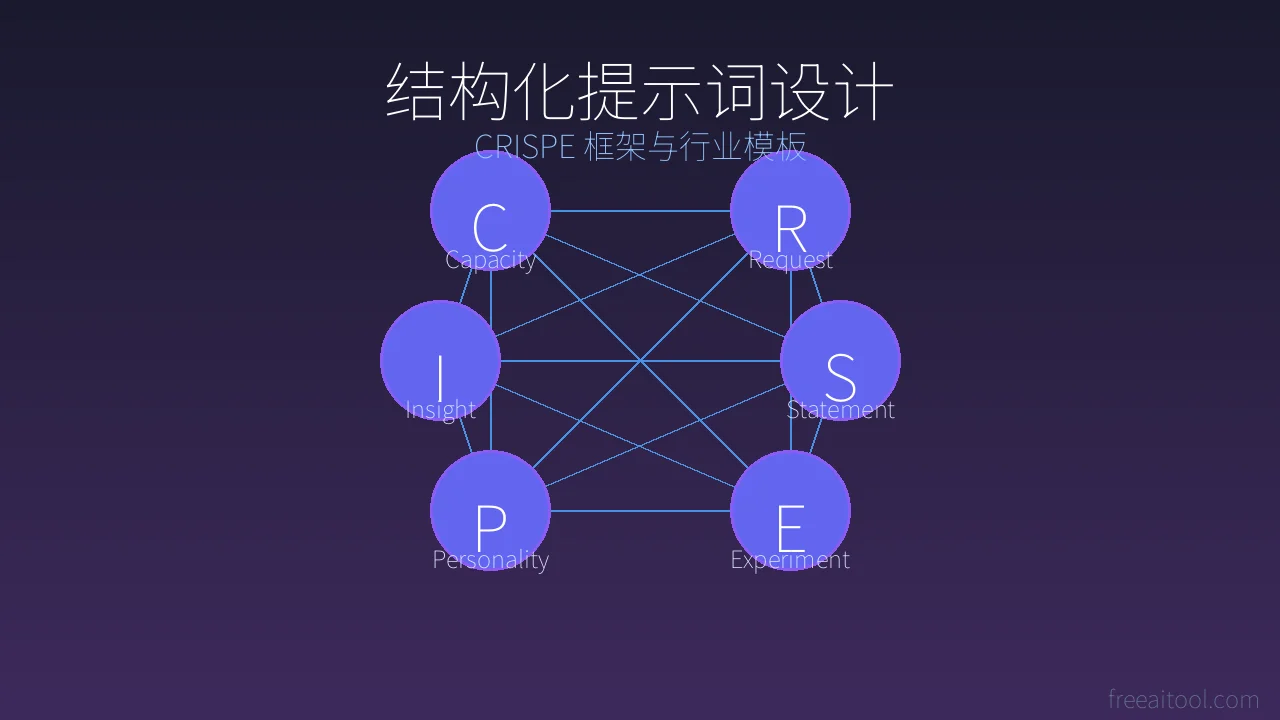
CRISPE is a battle-tested prompt design framework where each letter represents a critical dimension:
C - Capacity (Role & Capabilities)
Define the role AI should play and the professional capabilities it should possess. This is the “persona” part of the prompt, determining output professionalism and perspective.
{
  "capacity": {
    "role": "Senior Data Analyst",
    "expertise": ["Python", "SQL", "Statistical Analysis", "Data Visualization"],
    "experience": "10 years in internet industry"
  }
}
Key Principle: Role definitions should be specific to industry and years, avoiding vague “expert” descriptions.
R - Request (Task Request)
Clearly describe the specific task to be completed. Good requests should include clear deliverable definitions.
request:
  task: "Analyze user retention data"
  deliverable: "Analysis report with trend charts, key metrics, and optimization suggestions"
  format: "Markdown format, including code blocks and chart descriptions"
Key Principle: Task descriptions should include both “what to do” and “what to deliver.”
I - Insight (Background Context)
Provide contextual information related to the task, helping AI understand business background and data characteristics.
insight:
  business_context: "SaaS product with 500K monthly active users"
  data_characteristics: "Includes registration date, last login time, payment status"
  pain_point: "Retention rate dropped 15% in the past 3 months"
Key Principle: Background information should focus on key factors affecting analytical conclusions.
S - Statement (Output Specifications)
Define constraints on output format, style, length, etc.
statement:
  tone: "Professional but accessible, avoid excessive technical jargon"
  length: "1500-2000 words"
  structure: ["Executive Summary", "Data Analysis", "Problem Diagnosis", "Optimization Suggestions"]
  visual: "Include descriptions of 3 data visualization charts"
Key Principle: Output specifications should be quantified, avoiding vague descriptions like “detailed” or “concise.”
P - Personality (Expression Style)
Define the language style and emotional tone of the output.
personality:
  style: "Rigorous data-driven style"
  emotion: "Objective and neutral, moderately optimistic"
  audience: "Product managers and operations teams"
Key Principle: Style definitions should consider the target audience’s cognitive level.
E - Experiment (Iterative Optimization)
Reserve space for iteration, supporting multi-turn dialogue optimization.
experiment:
  iteration_strategy: "Output outline first, expand details after confirming direction"
  fallback: "If data is insufficient, clearly indicate missing fields"
  enhancement: "Proactively suggest 3 extended analysis directions"
Key Principle: Iteration strategy should clarify “confirm what first, then expand what.”
Variables and Placeholders Usage
The core advantage of structured prompts is templating. Through variables and placeholders, one template can adapt to multiple scenarios.
Variable Syntax
Double curly braces {{variable}} are recommended as placeholders:
template: |
  You are a {{role}} with {{experience}} of experience.

  Please analyze the following {{data_type}} data:
  {{data_content}}

  Output requirements:
  - Format: {{output_format}}
  - Length: {{word_count}} words
  - Style: {{tone}}
Variable Types
| Type | Example | Usage |
|---|---|---|
| String | {{role}} | Role names, style descriptions |
| Number | {{word_count}} | Length limits, quantity requirements |
| List | {{expertise}} | Skill lists, keywords |
| Object | {{data_content}} | Complex data structures |
Variable Default Values
Set default values for variables to improve template usability:
{
  "variables": {
    "role": {"default": "Senior Product Manager", "description": "Role AI plays"},
    "word_count": {"default": 1500, "min": 500, "max": 5000},
    "tone": {"default": "Professional and accessible", "enum": ["Rigorous", "Casual", "Motivational"]}
  }
}
10 Industry Template Examples
Below are 10 battle-tested industry templates that can be directly copied and used or adjusted according to needs.
Template 1: Data Analyst
capacity:
  role: "Senior Data Analyst"
  expertise: ["Python", "SQL", "Statistical Analysis"]

request:
  task: "Analyze {{dataset_name}} dataset"
  goal: "Discover trends and anomalies in {{metric}}"

insight:
  context: "{{business_context}}"
  data_size: "{{row_count}} rows × {{column_count}} columns"

statement:
  format: "Markdown Report"
  sections: ["Data Overview", "Trend Analysis", "Anomaly Diagnosis", "Action Suggestions"]
  length: "2000 words"

personality:
  style: "Data-driven, clear conclusions"
  audience: "Business decision makers"
Template 2: Content Creator
capacity:
  role: "Senior Content Strategist"
  expertise: ["SEO", "User Psychology", "Viral Headlines"]

request:
  task: "Write {{content_type}} for {{product_name}}"
  target_audience: "{{audience_description}}"

insight:
  brand_tone: "{{brand_voice}}"
  competitor_reference: "{{competitor_examples}}"

statement:
  format: "Markdown Article"
  structure: ["Engaging Opening", "Pain Point Resonance", "Solution", "Call to Action"]
  word_count: 1500

personality:
  style: "Vivid and engaging, triggering resonance"
  emotion: "Positive and uplifting"
Template 3: Code Review Expert
capacity:
  role: "Senior Software Engineer"
  expertise: ["{{programming_language}}", "Code Standards", "Performance Optimization"]

request:
  task: "Review the following code snippet"
  focus: ["Readability", "Performance", "Security", "Best Practices"]

insight:
  project_context: "{{project_type}}"
  team_standard: "{{coding_standard}}"

statement:
  format: "Line-by-line comments + Summary report"
  severity_levels: ["Critical", "Warning", "Suggestion"]

personality:
  style: "Constructive feedback, pointing out issues while providing improvement solutions"
Template 4: Product Manager
capacity:
  role: "Senior Product Manager"
  expertise: ["Requirements Analysis", "User Research", "PRD Writing"]

request:
  task: "Write product requirements document for {{feature_name}}"
  target_users: "{{user_persona}}"

insight:
  business_goal: "{{business_objective}}"
  technical_constraint: "{{tech_limitation}}"

statement:
  format: "PRD Document"
  sections: ["Background", "Goals", "User Stories", "Feature List", "Acceptance Criteria"]

personality:
  style: "Logically clear, data-supported"
Template 5: Marketing Copy
capacity:
  role: "Senior Marketing Copywriter"
  expertise: ["AIDA Model", "Conversion Optimization", "Psychology"]

request:
  task: "Write {{ad_type}} for {{product}}"
  platform: "{{platform_name}}"

insight:
  target_audience: "{{audience_pain_points}}"
  unique_selling_point: "{{usp}}"

statement:
  format: "{{platform}} ad copy"
  length: "{{character_limit}} characters"
  cta: "Clear call to action"

personality:
  style: "Eye-catching, desire-inducing"
Template 6: Technical Documentation
capacity:
  role: "Technical Documentation Engineer"
  expertise: ["API Documentation", "User Manuals", "Tutorial Writing"]

request:
  task: "Write {{doc_type}} for {{feature}}"
  target_reader: "{{reader_level}}"

insight:
  product_context: "{{product_description}}"
  common_questions: "{{faq_list}}"

statement:
  format: "Markdown Documentation"
  structure: ["Overview", "Quick Start", "Detailed Instructions", "FAQ", "Troubleshooting"]

personality:
  style: "Clear and accurate, detailed steps"
Template 7: Educational Tutoring
capacity:
  role: "Senior {{subject}} Teacher"
  expertise: ["{{subject}}", "Teaching Methods", "Student Psychology"]

request:
  task: "Explain {{concept}} for {{student_level}} students"
  learning_goal: "{{learning_objective}}"

insight:
  prior_knowledge: "{{student_background}}"
  common_misconceptions: "{{misconception_list}}"

statement:
  format: "Explanation + Examples + Practice"
  difficulty: "Progressive"

personality:
  style: "Patient and encouraging, good at using analogies"
Template 8: Customer Service
capacity:
  role: "Senior Customer Service Specialist"
  expertise: ["{{product_knowledge}}", "Customer Psychology", "Conflict Resolution"]

request:
  task: "Respond to customer inquiry about {{issue_type}}"
  customer_emotion: "{{emotion_state}}"

insight:
  company_policy: "{{policy_constraint}}"
  resolution_authority: "{{authority_level}}"

statement:
  format: "Customer service response script"
  tone: "Empathy + Solution"

personality:
  style: "Professional and gentle, quick response"
Template 9: Research Analysis
capacity:
  role: "Industry Researcher"
  expertise: ["{{industry}}", "Market Analysis", "Competitive Research"]

request:
  task: "Write research report on {{topic}}"
  research_scope: "{{scope_definition}}"

insight:
  time_frame: "{{research_period}}"
  data_sources: "{{source_list}}"

statement:
  format: "Research Report"
  sections: ["Executive Summary", "Market Overview", "Competitive Landscape", "Trend Forecast", "Strategic Recommendations"]

personality:
  style: "Objective and rigorous, data-supported"
Template 10: Creative Planning
capacity:
  role: "Creative Director"
  expertise: ["Brand Planning", "Creative Ideation", "Event Execution"]

request:
  task: "Plan {{campaign_type}} for {{brand}}"
  campaign_goal: "{{business_objective}}"

insight:
  brand_positioning: "{{brand_identity}}"
  target_audience: "{{audience_insight}}"
  budget_constraint: "{{budget_range}}"

statement:
  format: "Creative Proposal"
  deliverables: ["Core Concept", "Visual Direction", "Execution Plan", "Effect Estimation"]

personality:
  style: "Boldly innovative, practically feasible"
Building a Reusable Prompt Library
Systematize template management to build team-level prompt asset libraries.
Directory Structure
prompt-library/
├── templates/
│   ├── data-analysis/
│   ├── content-creation/
│   ├── code-review/
│   └── ...
├── variables/
│   ├── roles.yaml
│   ├── tones.yaml
│   └── formats.yaml
├── examples/
│   ├── successful-cases/
│   └── failed-cases/
└── README.md
Version Management
Use Git to manage prompt versions, recording the reason and effect of each optimization:
# templates/data-analysis/v2.1.yaml
version: 2.1
changelog:
  - date: 2026-10-15
    change: "Added outlier detection step"
    reason: "User feedback missed data quality issues"
    impact: "Output quality improved 30%"
Effectiveness Evaluation
Establish effectiveness evaluation mechanisms for each template:
{
  "template_id": "data-analysis-v2.1",
  "usage_count": 156,
  "success_rate": 0.87,
  "avg_rating": 4.3,
  "common_issues": [
    "Output truncation with large data volumes",
    "Chart descriptions not detailed enough"
  ],
  "optimization_history": [
    {"version": "2.0", "rating": 3.8},
    {"version": "2.1", "rating": 4.3}
  ]
}
Frequently Asked Questions
1. How does the CRISPE framework differ from other prompt frameworks like RISEN or TAG?
CRISPE’s advantage lies in its completeness and iterability. Compared to RISEN (Role-Instructions-Steps-End goal-Narrowing), CRISPE adds Insight (background context) and Experiment (iterative optimization) dimensions, making it more suitable for complex business scenarios. TAG (Task-Action-Goal) is too simplified, lacking role definition and output specifications.
2. How do you determine if a prompt is “structured enough”?
Three validation criteria: ① Can you replace variables to adapt to new scenarios without modifying the core logic; ② Is output quality stable (variation <20% across multiple runs); ③ Can team members understand and reuse the template. If all three conditions are met, the structuring level is sufficient.
3. Won’t too many variables make prompts complex?
The key is layered design. Core variables (role, task, output format) should be controlled at 5-7, with extended variables (style, length, audience) as optional configurations. Use default values to lower the usage threshold, allowing advanced users to override as needed.
4. How do you optimize existing prompt templates?
Adopt an A/B testing approach: keep the core framework unchanged, adjust only one variable at a time (such as adding an Insight dimension), and compare output quality before and after optimization. Record the reason and effect of each adjustment to form an iteration log.
5. Will structured prompts limit AI creativity?
No. Structuring provides boundaries rather than shackles. Good frameworks clarify “which parts need strict adherence and which parts allow freedom.” For example, output format needs structure, but creative ideation can be open. The key is finding the balance between “structure” and “freedom.”
Further Reading
- Master These 10 Tips to Become a ChatGPT Prompt Master
- AI Agent Tools Comprehensive Review: Cursor, Claude Code, n8n - Which is Best?
- 2026 Complete Guide to Best Free AI Tools
Summary: The core of structured prompt design is upgrading “random questioning” to “system engineering.” The CRISPE framework provides a complete methodology from role definition to iterative optimization, and the 10 industry templates can be directly reused. Remember, good prompts aren’t written once—they’re formed through continuous iteration and optimization. Build your prompt library to ensure every AI conversation produces high-quality results.
